

5 Things That Used To Cost Us Money But Are Now Free

If you have lived for any length of time, you would probably recognize inflation as one of the basic facts of life. And we're not just talking about how lifestyle inflation can cost you, the prices of the actual commodities you use on a day-to-day basis go up all the time. Or at least, they go up way more than they go down. You might even have seen prices for some consumer goods like olive oil double in just a few years. This is especially true when inflation rates are soaring. But other factors, like the new tariffs implemented by the Trump administration, have also implied that the price of some essential household items jumped according to new inflation data in 2025.
However, every now and then, we do come across certain anomalies as well. Entertainment and services like books, music, or credit freezes used to cost everyone considerably, but you can now access all of them without even opening your wallet. Even more historically expensive ventures like investments, GPS, and data storage are all things we can now take advantage of free of charge. The decline in prices of these commodities (or services) are often attributed to advancements in technology, favorable regulations, and the rise of competition among vendors.
You can access thousands of books without paying

There's a long history in fiction of bibliophilic characters stealing books from book shops, individuals, and libraries to get their literature fix. Thankfully, for avid readers across the globe today, there are multiple ways to get books without spending your money on them or risking an arrest. While books ceased to be as expensive as they were before the printing press came along, the range of access to free books that modern institutions provide is astounding, to say the least. Public libraries, for instance, only require you to provide a few documents for a library card. In exchange, you get access to a wealth of literature, magazines, and audiobooks completely free.
Admittedly, free libraries aren't a particularly recent addition to modern society, but the digital age has opened up more avenues for reading than ever. There's a whole new world of free e-books thanks to websites such as Project Gutenberg and Libby. These websites, and other similar applications, offer books for free for you to download and consume. Project Gutenberg has a collection of more than 75,000 books, many of them classics by the likes of Charles Dickens and Shakespeare. Libby, on the other hand, is like an online library: All you need is a library card and an internet connection and you're all set to borrow a book from the vast digital collections of libraries on the app.
You don't have to pay a commission on trading stocks

For a long time, the New York Stock Exchange (NYSE) had a minimum commission policy for their brokers. Adhering to this minimum commission rule was considered critical for "the financial welfare and the life of the Institution itself," according to the NYSE Governing Committee's statement back in 1894, per Financial Advisor Magazine. These days, you don't have to pay any extra brokerage fees for trading stocks or exchange-traded funds (ETFs). The trend was initially started by the free stock trading firm Robinhood, which eventually led to bigger firms like Fidelity and Charles Schwab following suit.
The first blow to the commission-based stock exchange system was struck by organizations like insurance companies that were trading extremely large quantities of assets in the mid-20th century. Brokers were naturally happy to help them, but in order to pocket large commissions for the same amount of work, they started bending the minimum commission rule. The subsequent blow to fixed commission rates came in the form of amendments to the Securities Acts in 1975, which meant that brokerage firms did not need to have a fixed charge on trades. In the decades since, the advent of discount brokers and computerized platforms for trading further ignited war on trading costs. This increased the interest and numbers of investors as well. Finally, in 2019, top firms in the industry, like Schwab, dropped their fees to zero, putting a permanent end to the race to the bottom.
Storing data was not always free or available to the masses
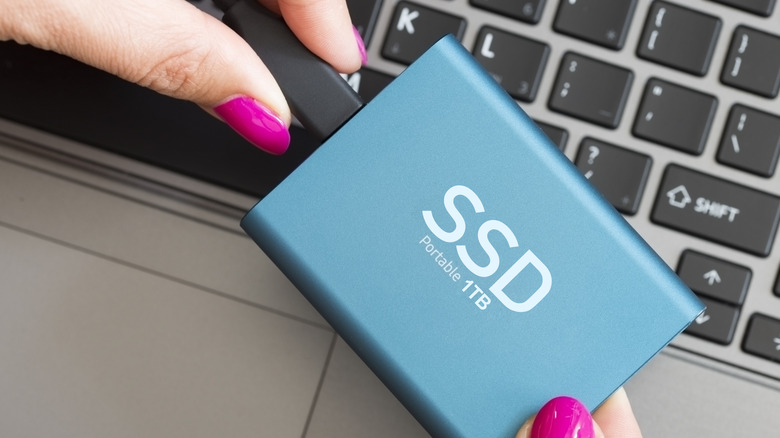
In recent years, applications like Google Drive or OneDrive have offered consumers immense peace of mind by giving them the tools to backup hundreds of gigabytes of photos and data for free. These resources have become so commonly used, it's hard to remember that this privilege wasn't always so affordable. In fact, it was pretty expensive for a time. Data storage prices have dramatically plummeted over the decades. According to research by computer scientist John C. McCallum, storing 256 gigabytes of data back in the '50s would have cost you $20 billion dollars by today's standards (via Our World in Data). As recently as the early 2000s, that amount of storage could still run consumers thousands.
These days, a gigabyte of storage costs mere cents. The decline has been largely made possible because of advancements in tech: Products like solid-state drives have gotten faster and cheaper, while competition and cloud adoption have made the technology more widely accessible. As the technology has continued to evolve, drives have also become more reliable, lowering the potential need to purchase replacements or pay for data recovery services.
You don't have to shell out $10 for a credit freeze

A credit freeze protects you from the risk of identity theft by blocking access to your credit report. In the event that someone gets sensitive information that could compromise your identity, freezing your credit could stop malicious people from opening up new accounts in your name. At a time when even shopping for loans could hurt your credit score, going this route does not have an impact on your credit score either.
Although credit freezes are free now, this was not always the case. Before the federal law intervened in 2018, you had to pay upwards of $10 to either freeze or thaw your account. This amount varied from state to state. The credit freeze was done by the credit reporting agencies: Equifax, TransUnion, and Experian. While these agencies are still in charge of the process, and you would have to get in touch with each of them to freeze your credit, you can now get it done for absolutely free. The change occurred after the Economic Growth, Regulatory Relief, and Consumer Protection Act was passed to protect citizens from major data breaches, like the Equifax breach that had exposed sensitive information belonging to nearly half the population of the country. Nonetheless, the majority of the population still does not take advantage of free credit freezes despite being aware of the option, according to a 2021 survey from the Identity Theft Resource Center.
There are lots of completely free options for GPS services

How often do you use Google Maps while driving around in your car? Whether they throw it on to find a route without too much traffic for your daily commute, or to search for nearby gas stations or restaurants, billions of users use some form of navigation every month without paying any fees. The Global Positioning System — better known as GPS — was initially developed by the Department of Defense for military requirements and reportedly cost billions of dollars to develop.
Back in 1989, commercial GPS units began to enter the market, albeit with a lesser efficiency than the ones designed for military purposes for the fear of being used by enemies against the U.S. The first of these units, the Magellan NAV 1000, was sold for $3,000. In the 2000s, GPS units were still sold at a few hundred dollars apiece. These days, all you need to get directions to just about anywhere is the receiver built into your smartphone or car. Sure, neither cars nor smartphones are cheap in their own right, but for many people, buying an external GPS unit is a thing of the past.