

5 Signs Jack In The Box May Not Survive Much Longer

The vast majority of Americans realize the health risks associated with eating fast food, but many indulge — at least occasionally — in consuming these quick-service meals anyway. According to YouGov, Americans cite taste and convenience as the main reasons for grabbing a meal at a fast-food restaurant. But in a study from Ipsos, about 40% of low-income and 30% of higher-income earners report they're eating out at fast-food establishments less frequently in 2025. This data helps confirm claims that the United States is currently experiencing a K-shaped economy. Unfortunately, this decline in fast food consumption is hitting many chains, including Jack in the Box, hard.
In fact, several signs indicate Jack in the Box may not survive much longer. These include location closures, a dwindling customer base, weakening sales, growing debt, and major asset sales. And while the 75-year-old company isn't the only restaurant facing financial woes, times are certainly tough for Jack in the Box. With a surprising number of low-income households living paycheck to paycheck, it's not too shocking to learn that even companies like McDonald's are taking pricing measures to lure customers back. How long Jack in the Box can survive, though, and whether the fast-food chain will pull through this decline in Americans dining out is hard to say. The company will likely need to make some major changes to its business model to pull through the economic downturn many restaurants in the U.S. are dealing with in 2025 and going into 2026.
More than 100 location closures are expected
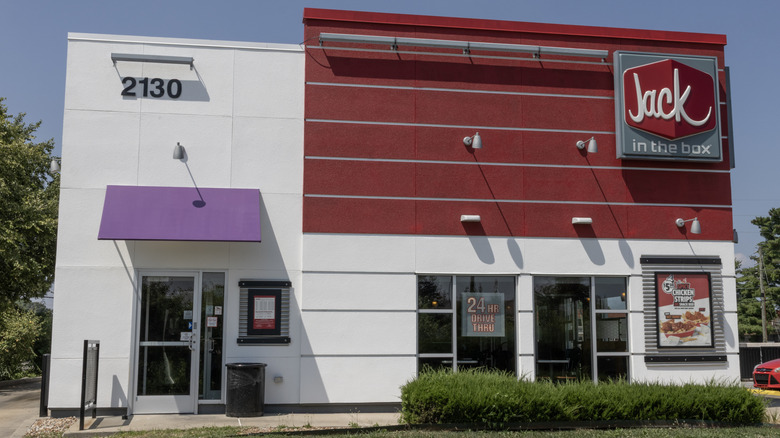
Several popular store chains are facing bankruptcy in 2025, causing stores to close across the nation. Although Jack in the Box hasn't filed for bankruptcy, part of its "Jack on Track" initiative includes a large number of store closures. An April 2025 press release from Jack in the Box states it plans to close between 150 and 200 underperforming locations, with many of these closures coming by the end of 2025. The block closure program will include stores that have been around for more than three decades, so this is likely to have ripple effects on the communities the QSRs serve. Since going out of business isn't just about having fewer dining options — as store closures also mean fewer jobs — the consequences of Jack in the Box's struggles are felt beyond the corporate office.
Along with shuttering its restaurants around the country, Jack in the Box plans to sell off some of its real estate holdings to generate cash flow. The fast-food chain has stated it doesn't plan to invest much in company-owned development for new restaurants in 2026. However, improving and creating new restaurant images will proceed as planned in an attempt to keep the Jack in the Box brand fresh and appealing.
Jack in the Box is losing its customer base
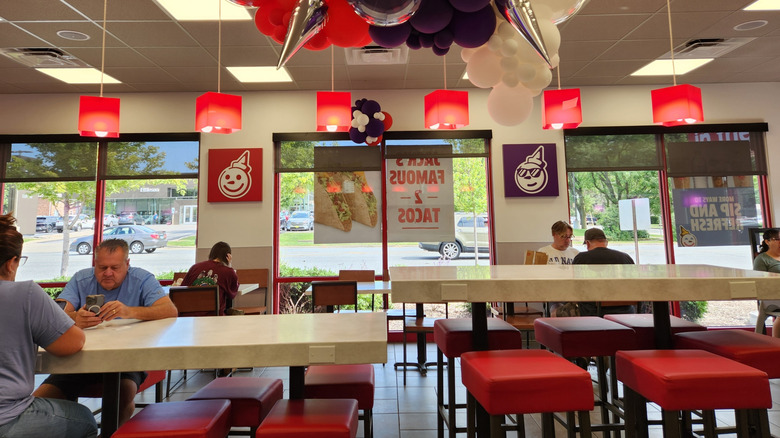
As with almost all fast-food chains, Jack in the Box continues to struggle with keeping its menu items affordable for consumers, which is leading to losses in its customer base. With food costs rising faster than overall inflation — the USDA reports that between August 2024 and August 2025, food prices rose 3.2% — the company is facing tighter margins than ever. It's also worth noting that Jack in the Box has a higher percentage of Hispanic customers than the general restaurant industry, according to NRN. This is significant because the Hispanic demographic is typically hit harder by high inflation than other consumer demographics, and this translates into fewer customers and lower sales for Jack in the Box.
Also, even though the chain targets a broad market of 18- to 49-year-olds, changes in general consumer eating habits are hurting the brand. Per data collected by Statista and presented on the World Economic Forum's website, 50% of Americans overall are trying to consume a healthier diet, which largely means less fast food. This trend adds yet another level of difficulty for Jack in the Box when it comes to maintaining a customer base.
Weakening sales are hurting the fast-food chain
Weak sales in both company-operated and franchise-owned stores is contributing to Jack in the Box's decline. The company's Q4 earnings report listed a 7.4% decrease in same-store sales, which also supports the fact that the fast-food chain is struggling to hold on to its customers. Sales plummeted 7.2% system wide in the fourth quarter, and Jack in the Box cites a decrease in transactions from patrons and an unfavorable menu mixed with price increases as the main reasons for its low sales. Del Taco, a restaurant in the process of being sold by Jack in the Box, also saw same-store sales fall 3.9% in Q4, while system-wide sales dropped 5.4%.
For 2024, Jack in the Box had a Q4 revenue of $349.3 million, but in 2025, this number decreased by 6.6% to just $326.2 million. This comes with an increase in expenses of $6.6 million, which is associated with higher insurance costs, wages, and brand advertising. Net earnings for Jack in the Box in Q4 of 2025 were a mere $5.8 million compared to its $21.9 million earnings from the fourth quarter of 2024. With dismal numbers like these, it's not surprising that company has discontinued its dividend for shareholders. The company's stock went from having $1.12 earnings per share in Q4 of 2024 to $0.30 per share in Q4 of 2025.
Jack in the Box sold Del Taco at a loss
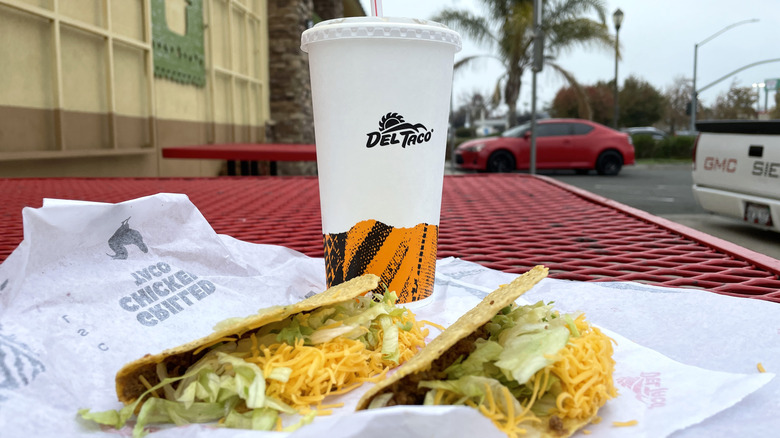
In 2022, Jack in the Box announced the purchase of Del Taco Holdings, which it acquired for $585 million. The company's CEO at the time, Darin Harris, said, "We have ambitious plans for our combined company, and we are excited for the many exciting opportunities ahead. Together, Jack in the Box and Del Taco will benefit from a stronger financial model, gaining greater scale to invest in digital and technology capabilities, and unit growth for both brands." Jump to 2025, and you'll learn that Jack in the Box's partnership with Del Taco didn't last. Sadly, Jack in the Box announced that it's selling Del Taco at a major loss. Yadav Enterprises Inc. is going to acquire Del Taco for a mere $115 million.
Lance Tucker, the current CEO of Jack in the Box, stated, "This divestiture is an important step in returning to simplicity, and we look forward to focusing on our core Jack in the Box brand." It seems as though the 2022 Jack in the Box CEO and the partnership he formed couldn't weather the struggling economy the U.S. is facing. In the Jack in the Box statement from October 2025, it reported that the sale of Del Taco will be finalized in January 2026.
Massive debt limits gains for Jack in the Box

Massive debt is another sign that Jack in the Box may not survive much longer. As of September 28, 2025, the U.S. Securities and Exchange Commission reported Jack in the Box as having a total of $1.7 billion in outstanding debt. With the company's sales declining, carrying such a high debt load is likely to have adverse effects. Limited growth potential is a big risk that comes with having a massive amount of debt, as it's difficult to refinance or restructure debt when low sales and high operating costs are plaguing the company and the restaurant industry as a whole. When cash flow is used to pay down debt, it means the restaurant doesn't have capital for expansion and growth.
If the economy continues to experience downturns or suddenly sees a spike in decreasing sales and a rise in unemployment, Jack in the Box could fall behind in its debt payments. The fast-food company also needs to expand and upgrade its technology, as more people are ordering online. Without the ability to borrow and fund the needed technological advancements, Jack in the Box will struggle to compete with restaurants that have the necessary tools to appeal to modern consumers. The likelihood for default is teetering on the edge right now for Jack in the Box, and its high debt load isn't helping.