

China's Trade Surplus Is Bigger Than Ever Despite Tariffs. Here's Why
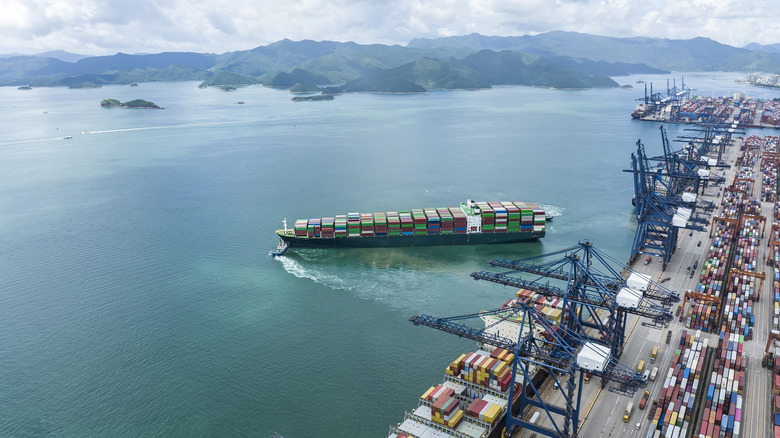
After months of economic strife, a trade truce of sorts was reportedly reached between the U.S. and China in late October 2025. The agreement was ominously preceded by President Donald Trump's social media post that had an unexpected effect on the stock market weeks earlier, and both domestic and foreign markets have shifted pretty radically in the months that have followed. In fact, within weeks of the truce's announcement, Reuters reports there was a 29% year-over-year drop in Chinese exports in November 2025. Meanwhile, in that month alone, China's trade surplus was $111.6 billion, with a 5.9% increase on Chinese exports from November 2024.
China's trade prowess is even more striking when you look at the year so far. In the first 11 months of 2025, China broke exporting records when it achieved a trade surplus of $1.08 trillion for the first time ever. In contrast, China's trade surplus in all of 2024 was just $992 billion, according to the Associated Press, citing financial data and analytics company FactSet. This momentous increase is largely due to the fact that China began exporting more to other parts of the world: In the same period that trade with the U.S. dropped so considerably, Chinese exports grew by 14.8% in Europe, 35.8% in Australia, and 8.2% in Southeast Asia, Reuters reported. As Peter Boockvar, chief investment officer at OnePoint BFG Wealth Partners, noted to CNBC, "China continues to rely less on selling stuff to the U.S.," and its behavior throughout 2025 certainly backs that observation up.
Trump's election spurred China to seek new trading partners
The pivot away from the U.S. was to be expected since President Trump has pushed tariffs as a means for increasing manufacturing in the U.S. and creating another revenue source for the federal government. He's even proposed this revenue source as a way to eliminate income tax, though that plan seems doomed to fail. Indeed, Trump's trade policy has been guided by the belief that China and the rest of the world have been ripping off the U.S. for years and that his taxes on imports, no matter how much they may inflate the price of essential goods or cause retaliatory tariffs that could pose a problem for the U.S. economy, was the way to set things right.
So, when Trump was elected to a second non-consecutive term in November 2024, China began improving trade relations with areas like the European Union and Southeast Asia. Additionally, under President Xi Jinping's Made in China 2025 strategy, China has spent much of the last decade investing heavily into its industrial base. This included immense government support for high-tech supply chains, which financial services and research firm Nomura reports helped enhance Chinese exports across the globe by almost 45% in the past five years (via CNN).
Chinese exports may be up, but the winds could change

For the short term at least, most experts believe that China's exports will continue to go up. Jing Wang, a chief economist at Nomura's Hong Kong office, told CNBC that he expects growth to "remain resilient" through 2026, but that growth will be less explosive over time. In fact, Wang went on to predict that China's export growth will revert to regular trends as "more countries impose trade barriers."
That may already be happening, as some governments have expressed concerns that China may be dumping its exports, meaning that it's selling products in foreign countries at price points much lower than they would sell for in their country of origin. The European Union, for example, recently imposed new tariffs on Chinese electric vehicles, as well as other regulations to minimize the possibility of this happening. However, Chinese exporters have the capacity to circumvent those trade barriers by building manufacturing facilities in other places like Vietnam and Indonesia, where tariffs are comparatively lower.
Still, some economists doubt China will be able to keep this level of exporting up forever due to domestic economic problems such as a meltdown in the Chinese real estate sector, brittle consumer confidence, and elevated unemployment among young adults. To strengthen its overall economy, China will need to "move into the next phase of its economic development," Lynn Song, a chief economist for ING, told Reuters. In Song's opinion, that means zeroing in further on domestic consumption.