

What Is A 'K-Shaped' Economy And Is The US Currently Experiencing One?
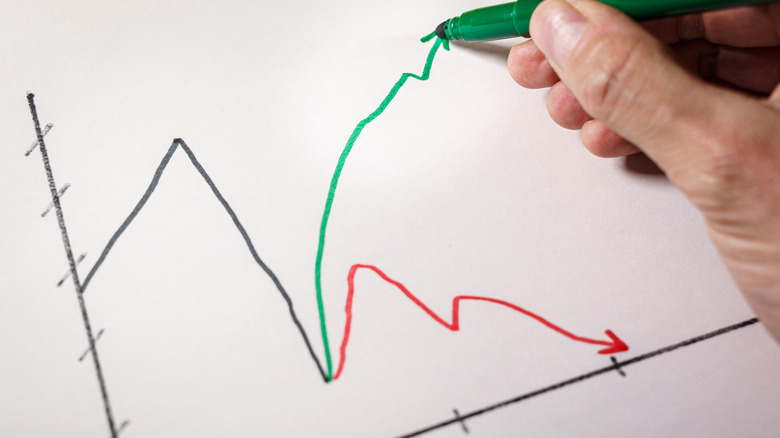
The state of the United States economy has been debated as 2025 comes to an end. Politicians — including President Donald Trump — and financial executives claim that the economy is strong. Meanwhile, working-class Americans are suffering, with the Bureau of Labor Statistics (BLS) reporting that the Consumer Price Index (CPI), an aggregate measure of average prices for consumer goods nationally, continues to rise. The rising prices are partly driven by high tariffs, with consumers ultimately paying for them. The disparity between the outlook for the working-class and the American elite is leading many national outlets, including the Associated Press, to claim the United States is currently in a K-shaped economy.
Economists often characterize markets using letters, such as the dreaded L-shaped economy, which indicates a recession. Currently, economists are noting a K-shaped economy, in which wealth and spending are growing among wealthy households, whereas wages and spending are shrinking among middle- and lower-class households. This outlook has been echoed by multiple Wall Street institutions, including J.P. Morgan, which, in its 2026 economic forecast, devoted a full page to the growing divide. Even some who staunchly argue for the health of the economy still note the divide between the upper and lower classes. Speaking at the end of November on the Bloomberg Podcast (via YouTube), Lakshman Achuthan, co-founder and chief operations officer at Economic Cycle Research Institute (ECRI), said, "Right now there is no stumbling on growth, and inflation is not running away, but the plutonomy is there." Importantly, plutonomy is defined as an economy driven by the growing spending of the wealthy.
A growing divide in the K-shaped economy is likely to persist in 2026

A 2025 Bank of America Institute article on Americans living paycheck-to-paycheck found that nearly a quarter of households nationwide spend all their money on necessities like rent and utilities. The same report found that the growth of wages among middle- and lower-class Americans is lagging behind inflation, while that of upper-class households is growing and remains above inflation. This trend is indicative of a K-shaped economy, and the institute predicts the disparity between wages and inflation will continue to rise in 2026, further squeezing the lower class. The Federal Reserve, as expected, cut rates in September and again in December, hoping to increase credit availability while consequently driving inflation further, hinting at the accuracy of this forecast.
The plutonomy noticed by Achuthan is important, as the top 10% of earners now contribute to nearly half of national consumer spending, according to Moody's Analytics data (via The Wall Street Journal). The possible reason for this is the rising value of assets, with the S&P 500 seeing its third consecutive year of growth. The value of stocks and hard assets like homes is expected to go up further as the currency becomes weaker, with experts having a grim prediction for the value of the U.S. dollar in 2026. With this in mind, the future of the American economy is heavily reliant on the stock market's health, while plutonomy and class divides may remain significant factors.