

3 Clever Ways To Save Money On Bacon
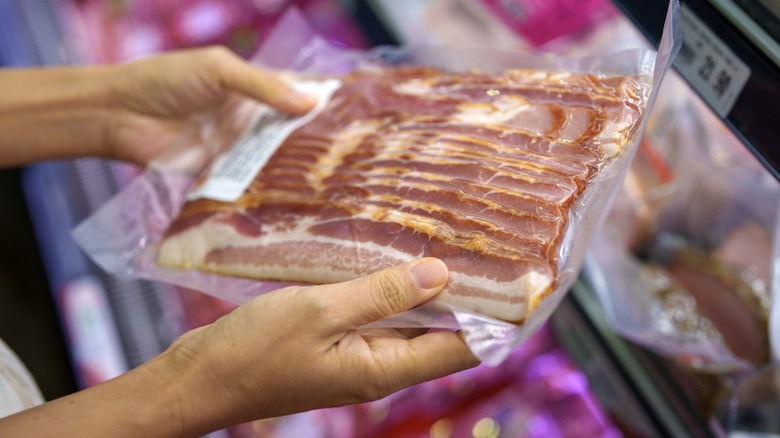
Bacon: the cornerstone of any nutritious breakfast, an American staple, and a growing, Chinese-company-dominated, 15-billion-dollar, money-making industry (via Verified Market Research 2025). Growing business is always good news, but when it's paired with record-high inflation and rising prices, it doesn't always translate into good news for the average American family.
Recent market reports estimate that the global bacon business will climb toward roughly $20 billion over the next decade, which points to steady demand in North America in particular. At the same time, federal price data shows that the U.S. average for "bacon, sliced, per lb." rose from about $5.45 in 2015 to around $7.21 in 2025, an increase of a little over 30%.
On the household side, a Bureau of Labor Statistics (BLS) blog using Consumer Expenditure Survey data found that the average U.S. household spent about $39.07 a year on bacon, even back when prices were lower. If you assume a similar amount of bacon today at roughly $7 a pound, that's easily $50 or more a year, before you even factor in how egg prices have historically ballooned and nudged some families to lean harder on bacon for breakfast protein. Regardless of your personal level of bacon insecurity, saving money is a good reason to get smarter about storage, shopping, and substitutions. And if you're already saving money by avoiding Costco for staples like this, a few well-chosen hacks can help you squeeze noticeably more value out of every pound of bacon you bring home.
Storing your bacon the right way
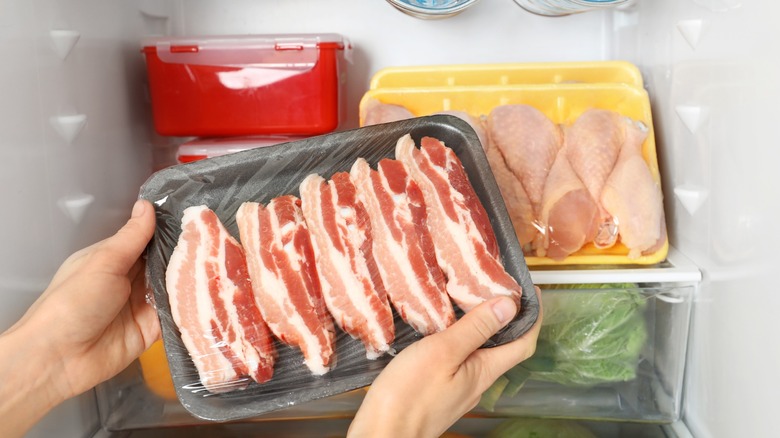
Most people open a pack of bacon, take a few slices, then shove the rest back into the fridge, but that's how you get bad bacon. The U.S. Department of Agriculture's Food Safety and Inspection Service says bacon should be used within seven days, or freeze it at 0 degrees Fahrenheit for up to four months for best quality.
The way you store it during that week also matters. Leaving the strips exposed lets them oxidize, dry out, and absorb fridge odors, which can push you to toss them early. Resealing helps keep air and moisture out and slows spoilage. You can do that by cutting the pack in half, using one half, then resealing the leftover half by sliding the now-empty packing over it.
If you won't use the rest within a few days, treat your bacon like a bulk buy and freeze it in smaller portions. One clever method, highlighted by Allrecipes, is to layer strips on parchment paper, roll them into little spirals, and freeze them individually. A basic roll of parchment costs around $4 and freezer-safe bags run maybe 10–20 cents each, so you're adding pennies per pound of bacon to potentially avoid throwing out an entire $7 pack that went bad. Saving even one pound of bacon from the trash basically "pays back" your storage supplies for multiple future packs.
Use the storage tips to save even more while shopping
Once you know how to store bacon properly, you can start using that knowledge to save real money at the store. With BLS data putting the 2025 national average around $7.20–$7.30 per pound (via Federal Reserve Bank of St. Louis), grabbing bacon only at full price adds up fast. If your household eats roughly 10 pounds a year, that's about $72–$73 at today's prices.
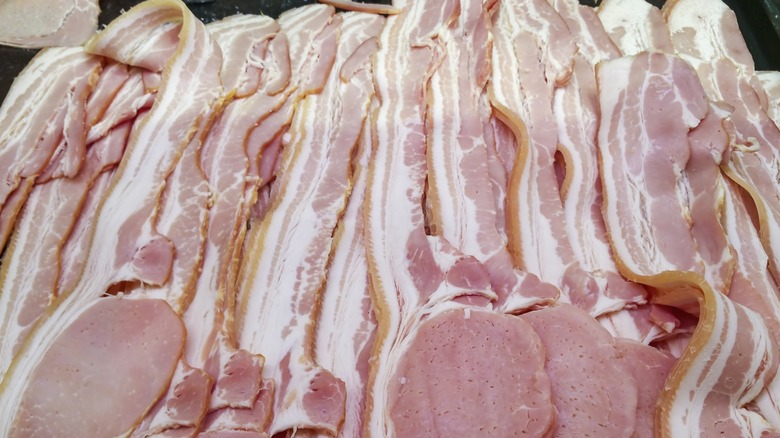
Supermarket circulars and price trackers routinely show store-brand bacon dipping into the $4.50–$5.00 per pound range during promotions, while name brands sit closer to $7 and up. If you use your freezer strategy to buy those 10 pounds only when they're on sale at $5 instead of $7, you're saving about $20 a year on bacon alone. You can stack those savings even further by deliberately buying bacon ends and pieces. These are the odd-shaped offcuts left after slicing the pretty strips, and grocery listings plus shopper reports show they often sell for 30–60% less per pound than regular retail slices, especially when on sale. If you swap just half of your annual bacon (5 pounds) into ends and pieces at, say, $5 instead of $7, that's another $10 back in your pocket.
Store-brand bacon at big-box chains also frequently undercuts premium labels by 15–25% per pound, and that's before loyalty rewards or digital coupons. For lighter bacon eaters, the math can even favor saving money by avoiding Costco for bacon altogether: a $65 membership fee only makes sense if your annual bulk savings on groceries (including bacon) comfortably clear that threshold.