

The Michigan Proposal That Would Eliminate Property Taxes
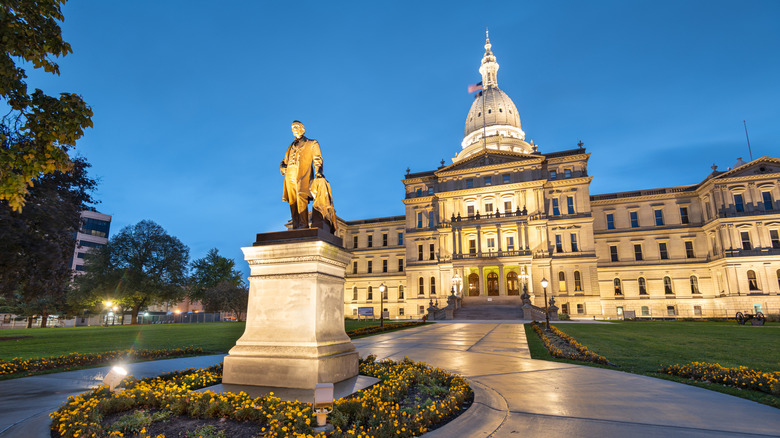
Michigan isn't one of the 10 states with the absolute highest property taxes, but it does have the 14th highest, according to the Tax Foundation. But if a recently launched ballot initiative has its way, Michigan would be the first U.S. state not to charge any property taxes at all.
AxMiTax, founded by Republican gubernatorial candidate Karla Wagner, is pushing for a Michigan constitutional amendment that would, among other things, ban the state, counties, and municipalities from charging property taxes. According to WSBT 22, Wagner said that property taxes are "the most heinous tax we pay" because they take away equity from property owners and could lead to the government taking away people's homes. "Our petition is to stop the government from taking property when people can't afford the government spending," Wagner said (via MLive). "What they're failing to understand is how many people lost their homes because of that pickleball millage or that parks and recs millage ..."
This would be AxMiTax's latest attempt. Its previous try failed to get the minimum signatures from voters needed to get on the 2024 ballot. This time around, Wagner and her group will need to collect 446,198 signatures by July 6, 2026 to get on the November 3, 2026 ballot. And they'll need to overcome opposition from local government officials who fear the measure will deprive them of precious tax revenue.
Eliminating property taxes in Michigan would slash $20 billion from public services

More than $20.3 billion in funding for schools, libraries, parks, sanitation, roads, senior programs, emergency series, roads, transit, and other services would disappear without the ability to tax properties. Tony Minghine, deputy executive director of the Michigan Municipal League, compared the elimination of property taxes to cutting off one's leg to lose 20 pounds, "There's no scenario where the cities, wherever you live, could be expected to operate anywhere close to anything you recognize now," Minghine said (via MLive).
AxMiTax's plan to recover the lost tax revenue entails increasing cities' share of sales tax from 10 to 13.33% and enabling counties to take 6.67% of sales tax instead of 0%. The amendment would also divert 10% of Michigan's income tax collections, as well as tax revenue levied on marijuana, alcohol, and tobacco sales, toward local governments.
However, those tax dollars could only be used for essential government and infrastructure services and not parks or schools. That would mean Michigan education budgets would still need to slash more than $11.6 billion each year, per MLive. Plus, the amendment would require any new local taxes to be approved by a referendum of at least 60% of voters. Meanwhile, any state tax hike above 0.1% over five years would have to be ratified by two-thirds of the state legislature.
AxMiTax founder says the government is overfunded
Wagner said government spending has gotten out of control and that roads and public safety should be top funding priorities. She has also said (via MLive) that libraries and parks can be funded with user fees while public schools could be supplemented with donations from philanthropists and businesses now enjoying the massive tax break or feeling freed from the threat of having their properties seized by state government.
But Minghine told MLive that getting rid of property taxes won't create an economic boom as Wagner expects. Instead, it will make people move out of Michigan as schools and services fail. "... life as we know it in this state would literally cease to exist," he said, adding that "everything would be a shell of what it was and it would hit all communities devastatingly hard ..." (Also, real estate investors are already flocking to Detroit, even with the high property taxes.)
This dystopian scenario likely won't happen because AxMiTax will struggle to gather the signatures needed in time, opined CityPulse columnist Kyle Melinn. Plus, longtime Michigan dwellers would remember that the last time property taxes were merely lowered the state taxes went up, Melinn added; indeed, the Tax Foundation found that getting rid of property taxes would require increasing income taxes from 4.25% to 11.93%. Meanwhile, Republican candidates and current state legislators are coming up with other ideas to lower, but not eliminate, Michigan property taxes. "So what I'm looking at is potentially two competing proposals, working through the Legislature to put that on the ballot in giving the people of Michigan two choices," Republican House Speaker Matt Hall told Michigan Public.