

The First Ever McDonald's Big Mac Was More Than 10 Times Cheaper Compared To Today
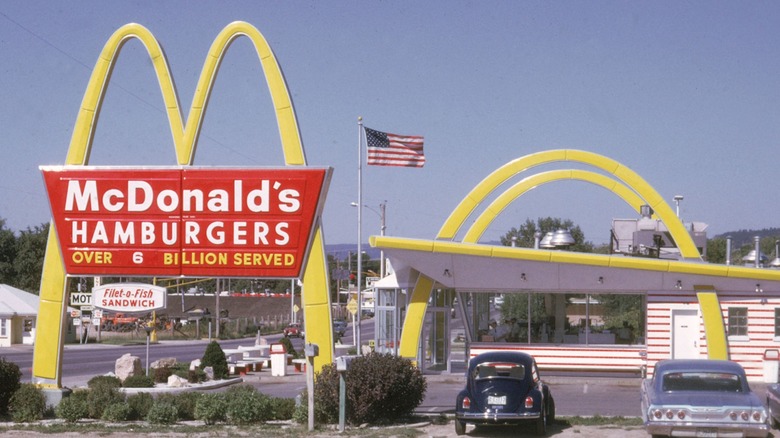
It might shock you to know that the first McDonald's Big Mac wasn't made by the original owners of the restaurant, but by franchisee Jim Delgatti in 1967 (10 years after Burger King's first Whopper) at his Uniontown McDonald's in Western Pennsylvania. But even more shocking to modern customers could be that the Big Mac launched at the low price of 45 cents, according to The New York Times. Meanwhile, as of 2025, Economist's Big Mac Index puts the average price of the sandwich in the United States at $6.01. That means that the chain's first ever Big Mac cost 13 times less back in 1967 than it does in 2025 (without accounting for inflation).
Note that you may see varying prices being quoted if you're researching the history of the first Big Mac. That's because when corporate McDonald's launched the Big Mac nationally one year after Delgatti's successful regional experiment, its price rose to 49 cents, according to a historical entry in Pennsylvania Center for the Book.
How the price of the first Big Mac compares when you factor in inflation
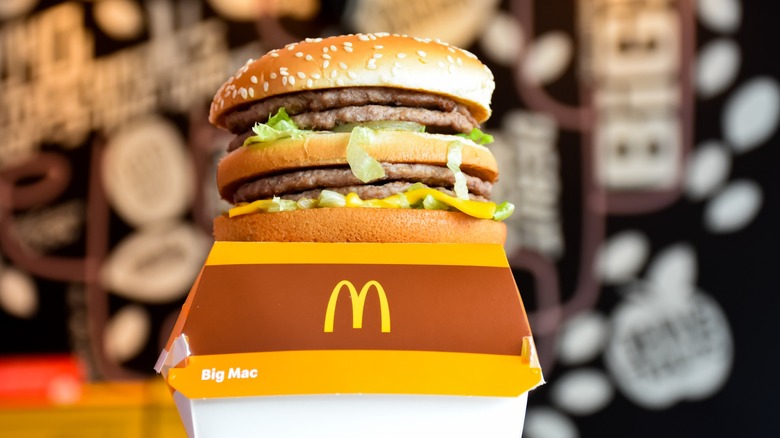
Big Mac's original 1967 price of 45 cents works out to $4.42 in September 2025 dollars, according to the Bureau of Labor Statistics' (BLS) CPI Inflation Calculator. That means that the price of a Big Mac is about 30% higher today when adjusted for inflation. When you consider that the typical worker's real pay has risen only around 10% since the early 1970s, according to analyses of BLS wage data by the Hamilton Project and the Economic Policy Institute, you can see that Big Macs are now less affordable for the average worker than they used to be in the mid-20th century.
The price increase can be partly explained by rising ingredient costs, particularly beef. U.S. beef prices have been trending upward for years due to higher feed costs, drought-related supply constraints, and increased processing expenses — all factors that filter into the final price of a Big Mac. These pressures help explain why the burger's real-dollar cost has climbed faster than general inflation, even as there are still ways to save money when ordering a Big Mac, such as through app-exclusive deals or limited-time promotions.
Another useful point of comparison is how Big Mac prices differ internationally. According to The Economist's Big Mac Index, the price of the same burger can swing dramatically depending on where you buy it. Countries like Switzerland and Norway generally have the priciest Big Macs in the world. Meanwhile, nations in Southeast Asia and Eastern Europe typically have lower prices for this McDonald's favorite. These gaps indicate that Big Mac prices are determined by local food prices, labor costs, and the general economic climate.