

The Consumer Reports Rating Scandal That Hurt This Vehicle In The 90s

Consumer Reports has a reputation for being a trusted source of information on the quality of products you want to buy. So when CR says a new car is one of the worst deals or that an SUV is unreliable for more than one reason, you would likely take its word for it. And doing so wouldn't be unfounded, as the company typically rates and ranks many products without bias. Unfortunately, in its history as a consumer products rating agency, Consumer Reports, once called the Consumer Union, has been known to make mistakes in its findings. In one instance, CR gave a vehicle a rating that caused trouble for a brand in the United States during the 1990s.
According to what was then the Consumer Union, the 1988 Suzuki Samurai was said to "easily roll over in turns". The consumer reporting agency gave the 1988 Samurai a 'not acceptable' rating based on a crash-avoidance test video showing the SUV tipping over onto outriggers at 40 mph. Although the National Highway Traffic Safety Administration (NHTSA) refused to issue a recall, the negative publicity that ensued from the report had a major impact on the small Suzuki's sales. According to Automotive News, Samurai sales shrank to 2,000 units the year after the report, falling from 72,000 units the year before. This caused Suzuki to discontinue the Samurai in the U.S. by the mid-90s. Then, in 1996, Suzuki filed a libel suit against CR, claiming it had been defamed and disparaged by the rating agency.
Was the Suzuki Samurai prone to rolling?
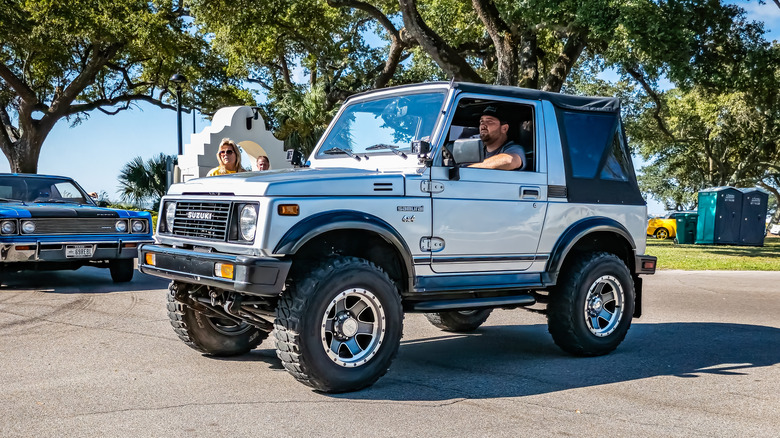
The first Suzuki Samurai hit the U.S. market in 1986, and its sales skyrocketed rapidly. It came out at a time when SUVs were still new, and modern safety standards had yet to be introduced, so the SUV wasn't without its share of problems. But did it have a higher tendency to roll than similar models at the time? A CarBuzz article states that an internal memo from Suzuki revealed that executives had concerns over the Samurai's narrow wheelbase that made it bound to roll over. However, the memo also mentions that the problem is similar to that of its Jeep competitor. MotorBiscuit reveals that Consumer Reports altered its testing to obtain its results, reporting that when driven by pros on the course the agency had used for 15 years, the Samurai wouldn't tip even at 55 mph. It was only after attempts by a nonprofessional driver that the SUV would, in fact, roll.
Even today, because of their high center of gravity, SUVs are more prone to tipping or rolling than other vehicles, especially during sudden changes in direction or when traveling at high speeds. And the Suzuki Samurai wasn't the first, nor would it be the last, to get a rating of 'not acceptable' from CR. So while the bad CR rating and publicity undeniably hurt the Samurai's sales, it may not have been the SUV's only downfall. Its increasing price point was likely also a contributor to its diminishing sales.
What was the end result of the Suzuki lawsuit?

After Suzuki ended sales of the Samurai in North America, the automaker filed a lawsuit against Consumer Union in the U.S. District Court for the Central District of California. The original case was dismissed, but an appeal was filed in 2002, reopening the case for several more years. Of course, the damage had been done, as Suzuki was no longer selling the Samurai by this time and hadn't been for years. It wasn't until 2004 that the two parties finally came to an agreement. Although neither party received monetary compensation, there was some reconciliation between them.
A statement from Consumer Reports outlines the results of the settlement. The statement says that the parties still don't agree about the validity of the testing of the 1988 Suzuki Samurai, with Suzuki disputing the findings and CU standing by its testing protocol. The two parties do agree, though, to a mutual respect, with both recognizing one another's strengths. CU acknowledges that Suzuki strives to design, market, and manufacture safe vehicles. Suzuki, on its part, acknowledges CU for its unbiased and objective testing and reporting methods. The rating agency does claim its findings may have been misconstrued and misunderstood, as it never meant to imply the Samurai tipped or rolled more easily than its competitors. Regardless of what Consumer Reports says now, the rating scandal hurt the Samurai in the 90s, possibly more than the largest brake recall in recent history that cost BMW a ton of money.