

Why Buying Homes Near A Cemetery Could Be A Savvy Investment
It's very hard to ignore the sharply rising home prices happening across the country. Just like grocery costs surging since the 1970s, buying a home has become more of an achievement than it used to be in the late 20th century — and even earlier in the 2010s. If you're among the lucky Americans who have amassed enough savings to buy a house, it's all the more important to approach the decision strategically. That often means looking beyond traditional assumptions and recognizing when an unconventional choice can offer long-term benefits.
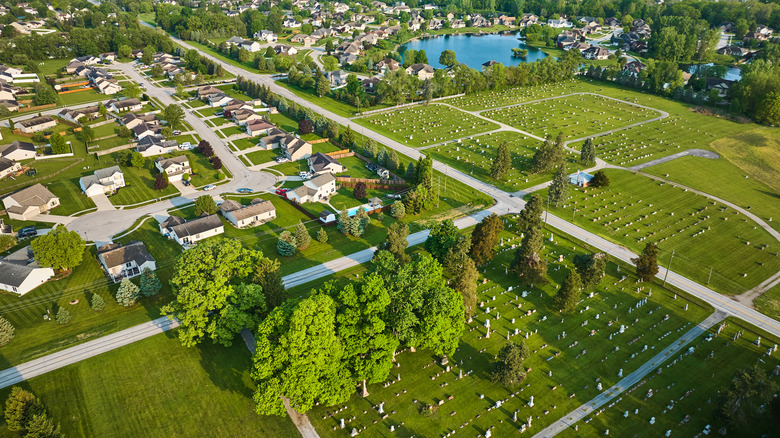
One surprisingly smart option is buying a home near a cemetery. While the idea may feel unsettling for psychological or religious reasons, these properties can offer advantages that other neighborhoods can't. Cemeteries are about as "development-proof" as it gets — meaning you're far less likely to see a shopping center, major road project, or high-rise appear next door and affect your property value. Many are also generally well-maintained, with state and local rules requiring consistent upkeep, which helps stabilize the surrounding neighborhood's appearance over time.
Buyer hesitation can also work in your favor, reducing competition and sometimes improving the deal you can get. Research on the subject appears mixed, or maybe they've just changed over time. According to PR Newswire, in 2013, Redfin published a national study showing that houses closer to cemeteries were smaller but more expensive per square foot, while Realtor.com found in 2022 that similar homes near cemeteries were roughly 12% cheaper.
Viewed together, these findings make sense. You can absolutely have valuable homes next to cemeteries, while nationwide, neighborhoods with cemeteries tend to skew slightly cheaper overall. For buyers who care about long-term stability, predictable surroundings, and the reduced risk of disruptive development, a home near a cemetery can be a genuinely savvy investment.
The pros and cons of buying a home next to a cemetery
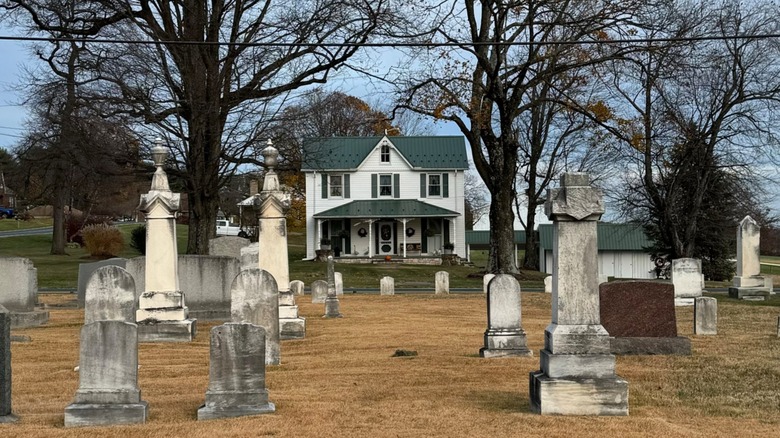
Ideally, cemeteries are well-maintained park-like locations that the state and/or local governments mandate should be kept in good condition. In most states, part of the obligation for running a cemetery is showing how you can fund long-term maintenance. Some states, like Virginia and Mississippi, have a perpetual care fund that mandates that the proceeds from it must go into maintaining the cemetery. This means that you're virtually guaranteed to have a nicely kept neighborhood, whereas having another household as a neighbor doesn't guarantee you the same dedication to aesthetics. There's also the fact that cemeteries are semi-permanent fixtures; the possibility of the land being bought up and turned to something else is very low, and that could give you better security in your home investment.
The counterargument for a cemetery-adjacent house, negating the psychological toll it may have on some (especially children), is that most of them are still public locations. Burials are solemn, serious affairs that are done quietly, but that's still the chance that you might stumble upon a horde of strangers in black on any random weekend. All of that is on top of the fact that buyers will still hesitate to snag up a house next to a cemetery, as proven by Redfin's study, with data suggesting houses with cemetery proximity spent longer on the market. If you want a property that will move quickly when you want to sell it, you might not want to go with one near a cemetery. However, the difference is only about 23% longer on average (39 vs 48 days), which isn't much when you consider that selling a house is a decision that usually takes months.