

The Most Iconic Car Of The Last 75 Years Is Also One Of The Deadliest
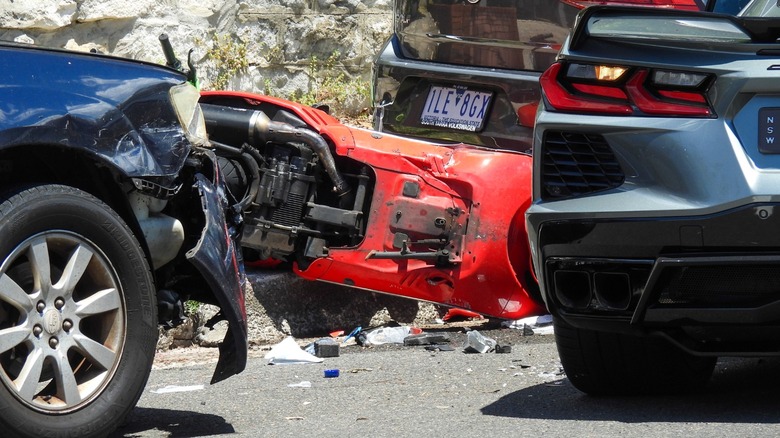
The term "American sports car" is synonymous with the Chevrolet Corvette. And that's not just because of how ubiquitous it has become in pop culture; it's one of the few cars that have constantly been around since the 1950s. The Corvette has spanned eight generations since its debut in 1953, making it the longest-running continuously produced American passenger car, beating favorites like the Ford Mustang or the Dodge Challenger and Charger. The design has evolved a lot since the mid-20th century, but the Americanized European-style sports-car essence and attainable price tag have pretty much stayed the same in those many decades. It's no wonder the Corvette topped MotorTrend's reader survey for the "most iconic car of the past 75 years," and some older, common Corvettes can even sell for a small fortune over 50 years later.
However, because of their blistering performance and attainability, the modern Corvette generations (C7 and C8) rank alarmingly high on iSeeCar's report on the most dangerous cars. The study was based on fatality data from the National Highway Traffic Safety Administration (NHTSA) Fatality Analysis Reporting System (FARS), and it was conducted on cars from model years 2018 to 2022. The Chevrolet Corvette is second on the list, with 13.6 fatalities per billion vehicle miles, 4.8 times more than the average, and only second to the Hyundai Venue. These numbers make it seem like one of the deadliest cars of modern times, but that may be down to how it's driven rather than just how it's built.
Is the Chevrolet Corvette dangerous to drive?
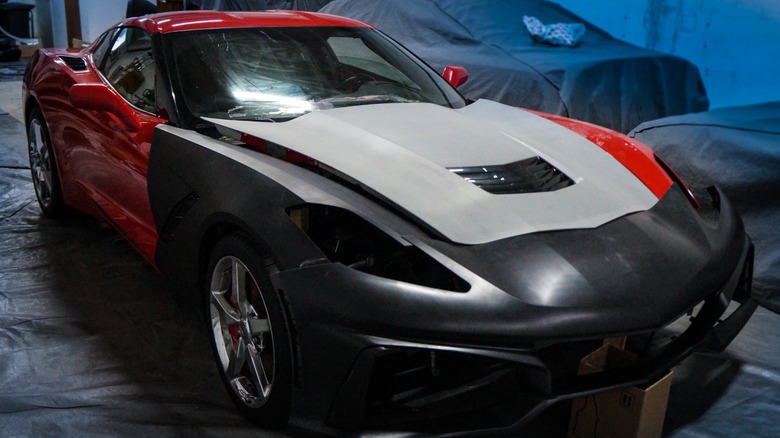
As iSeeCars pointed out in its analysis, this data doesn't mean that the Corvette by itself is unsafe. Even though the NHTSA hasn't yet published a safety rating, nor has the Insurance Institute for Highway Safety (IIHS) conducted crash tests for the C7 and C8, the other cars on the list did relatively well in crash tests and scored high safety ratings from the relevant agencies. That suggests the numbers are against the Corvette, likely because it's a relatively attainable performance car with a lot of power per dollar. For instance, the 2020 (and later) C8 Stingray starts around 495 horsepower, and the Z06 and ZR1 are far more powerful. It's not a car people buy to drive as a responsible economy or everyday car, so when a crash happens, its use case and powerful capabilities raise the ceiling for how bad the accident can be. Therefore, it may come down to the driver and why they're in a Corvette in the first place.
While the analysis filtered out low-volume cars to keep the report as fair as possible, the Corvette is still far less common than something like a Camry or an F-150. The lower number of Corvettes, along with the higher chance of fatal crashes due to their typical use and performance, could increase the number of fatalities per mile, because there's more risk for each mile. It also doesn't help that it's a smaller performance car, and both sports cars and smaller cars have the highest rate of fatal accidents, per the iSeeCars report.
Is the Corvette still worth buying ?
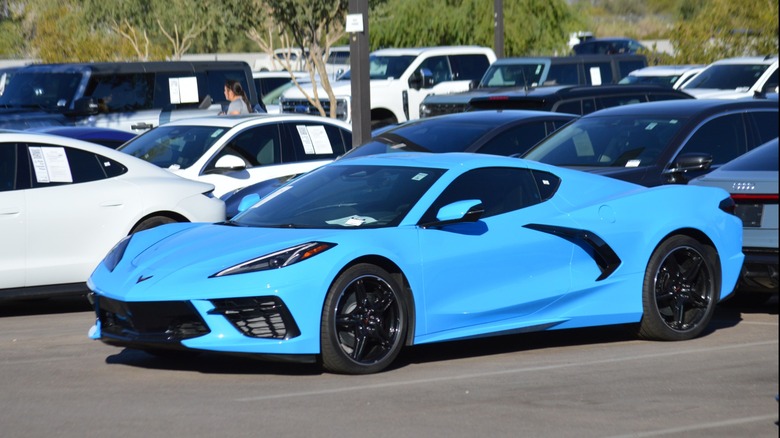
If safety is your biggest concern, the Corvette is not the car for you. There are many safer, cheaper, reliable, and practical cars out there — some even come with performance options that let you get the best of both worlds. Many such cars have high safety ratings from the NHTSA and good IIHS crash test scores. With the limited budgets these car safety agencies have, they have to prioritize more common car models, and they don't often run tests on dedicated sports cars.
Even among other sports cars, the Corvette's high ranking in fatalities is cause for concern. In fact, another two-seater sports car, the MX-5 Miata, has among the lowest fatality rates of all cars, according to an analysis of FARS data cited by Koester Legal. Interestingly, the MX-5 is smaller than the Corvette, but has much less power and more robust safety features in its base trims. The Corvette's safety features are lacking so badly that the C8 generation is one of the only recent car models lacking automatic emergency braking (via TheCarConnection).
That said, if you want an American performance car that flirts with supercar speeds without the supercar price tag, the Corvette could be the answer. The older generation C7 goes from $30,000 to $80,000 on the used market, depending on mileage and trim, and you can get a base trim C8 Stingray for around $70,000. That's less than what you'll spend on many good-value luxury cars, which means that it's a good deal if you're a car enthusiast who's looking for performance and not much else.