

The World's Largest Fast Food Chain Isn't McDonald's Or Starbucks
McDonald's and Starbucks are household names. The brands drive enormous sales revenue every year, and they're some of the world's largest employers. So you'd be forgiven for assuming that at least one of them must be the world's largest food chain as well. Starbucks, for instance, has more than 40,000 stores across the world. McDonald's, on the other hand, boasts of more than 44,000 global locations and has been consistently growing worldwide. In fact, if you would have invested $1,000 in McDonald's 10 years ago, you would have more than tripled your investment. Nonetheless, none of these mega-successful companies are No. 1 in terms of total number of outlets. It may surprise you, but with more than 45,000 stores on the world map as of September 2024, Mixue Bingcheng — a Chinese ice cream and tea restaurant brand— is currently the largest fast food chain in the world. Not only has the company gained immense popularity throughout Asia, but it has also capitalized on this demand by scaling at a rapid pace.
Zhang Hongchao, founder of Mixue Bingcheng, started the business when he was still a student with a simple idea of providing affordable drinks and ice cream to workers and students. The company was founded in 1997 in Zhengzhou, still a newbie in comparison to, say, the Golden Arches, which began 85 years ago. Nonetheless, in a relatively short time, the brand has left a lasting impression on the hearts of its consumers with the affordability of its offerings as well as the quality of its service.
Mixue Bingcheng offers cheap eats and sells products to its franchisees
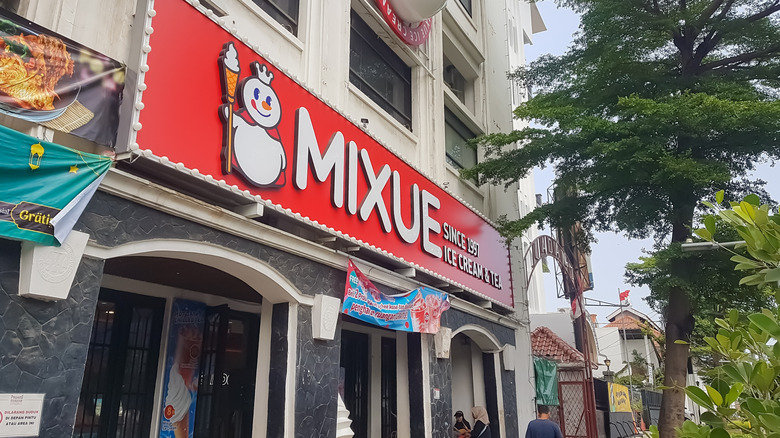
So what really differentiates Mixue from its competitors across the globe? Well, to begin with, the cost of its offerings. The pricing strategy revolves around the founder's intention to "let people around the world eat well and drink well for just two American dollars," as told by the founder to Chinese state media, per Eat This Not That. The price of a soft serve ice cream cone is only 15 cents, whereas beverages start from 30 cents. Such low-cost products are one of the primary reasons why Mixue has been able to thrive despite global economic crises that have shaken up other brands. In fact, considering just how much the average American spends on fast food, it comes as no surprise that fast food brands in America are turning to similar, budget-friendly strategies, like value meals, to further expand their customer base.
Apart from the price advantage, Mixue also stands out by selling ingredients and packaging materials to its own franchise owners (which amount to 99% of the brand's outlets) and driving a majority of its revenue this way. These ingredients include things like coffee, milk, and syrups. In fact, according to the company's prospectus, the ingredients and packaging material comprised nearly 90% of its earnings in 2021. Additionally, franchises need to pay for other expenses, such as operational guidance and daily management provided by the company.
Mixue Bingcheng's expansion strategy has been extremely successful
Mixue has been constantly expanding its empire ever since opening its first overseas outlet in Vietnam back in 2018. With more than 4,700 stores in 11 foreign countries, including Australia, Thailand, Singapore, and Japan, the brand's global expansion has been unthwarted by the pandemic and continues to maintain impressive profits. However, the crux of its expansion success is largely attributed to the low-cost entry for its franchisees.
Mixue has also made it extremely convenient to start a franchise — in terms of area, expertise, staff, and capital requirements. This comes at a time when opening a franchise could be one of the worst businesses to start today — you may need well over 1 million dollars in starting capital to start a McDonald's, alongside further operating costs down the line. Franchise owners can also leverage the brand's name as well as its training and support to maintain a standard quality of service, no matter where the store is. Mixue's successful franchise-based model is one of the major reasons why it has been able to penetrate the lower-tier cities in China and thereby outcompete other brands that have largely remained in the cities. Needless to say, the future looks bright for this fast food chain.