

The Valuable Nickel That's Worth More Than $125,000
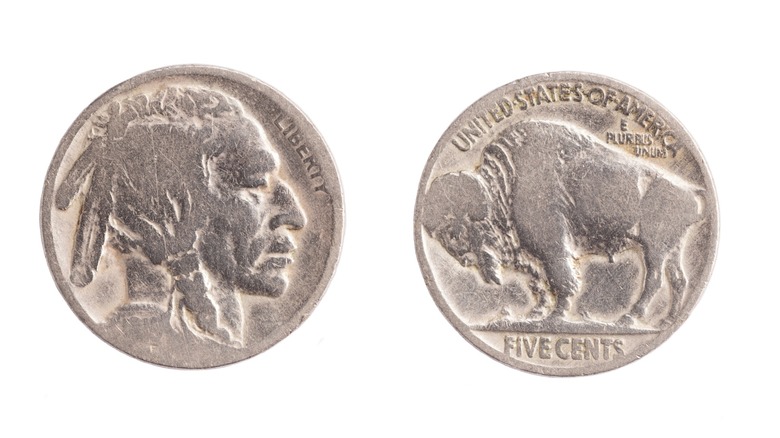
Coin collecting can be considered a niche hobby. With that said, just like with antique books or even old furniture, this hobby can also be extremely lucrative or expensive, depending on what side of the auction aisle you're on. For casual observers, a nickel might just be spare change, but for seasoned collectors, certain pieces can carry extraordinary value. One example of this is the 1918 Buffalo nickel, in which different varieties can all fetch considerable amounts of money.
One variety — the rare Denver Mint overdate, known as the 1918/7-D — was struck when a 1917 die was accidentally reused and repunched with an "8," leaving a faint "7" visible underneath. This quirk makes the coin one of the most desirable coins among American collectors. In pristine condition, or rather Professional Coin Grading Service (PCGS) grade MS65 — the company's highest known grade — this error nickel has sold for as much as $350,750 at auction.
With that said, 1918/7-D coins are rare, and you're far more likely to encounter a 1918-S Buffalo nickel out in the wild. Struck during World War I when demand for war goods was at a peak, relatively few were produced, and even fewer survived in pristine condition. One example of this coin in Numismatic Guaranty Company (NGC) grade MS66 — an almost flawless mint condition – sold for $125,350 in 2008, and would likely bring a similar or even higher figure today. It may not have the legendary status, and consequent value, of its overdate cousin, but it certainly has earned its place among the rare coins you don't want to throw out.
Why 1918 coins have become so valuable
Many elements can go into a coin's value today — scarcity, design, age, and condition. However, another element that can also make a coin more valuable is how much history it has, and what kind of history. With the U.S. still engaged in World War I, the U.S. Mint was under pressure to keep coins in circulation. As coin dies were reworked in haste, errors occurred that lead to unique batches of coins in 1918. These small imperfections are now exactly the kind of anomaly that collectors pay a premium for, in part because the coins contain a very specific part of history within them.
Adding to the appeal of 1918 coins, in particular, is their inherent fragility. The date, and the buffalo's horn, sat at high points on the die, which meant they wore away quickly in circulation. This can make finding examples in pristine condition even more difficult. One notable variety is the 1918-S Buffalo nickel, struck at the San Francisco Mint location. With a smaller mintage — at under five million – most of these coins saw heavy circulation along the West Coast, very few high-grade survivors remaining today.